Male Enhancement Pills vs Testosterone Boosters: Which One Actually Matches Your Goal?
Quick Answer: Male Enhancement Pills vs Testosterone Boosters — What's the Difference?
Male enhancement pills and testosterone boosters target different goals. Enhancement formulas usually work on blood flow and libido in the short term, leaning on circulation actives. Testosterone boosters support hormone production over eight to twelve weeks. Some formulas overlap, so match the ingredient to your goal and read the label.
- Male enhancement pills: short-term circulation and libido support, often built on L-citrulline.
- Testosterone boosters: slow hormone support over 8–12 weeks, built on ashwagandha, zinc and vitamin D.
- The rule: pick by the ingredient and the goal, not by the label on the front.
Shop the men's aisle and two product types dominate the shelf: male enhancement pills and testosterone boosters. They sit side by side, wear similar packaging, and use overlapping language, which is exactly why so many men buy the wrong one for their goal. The truth is simpler than the marketing: male enhancement pills and testosterone boosters are aiming at different targets on different timelines. Get the distinction right and you buy the product that fits the outcome you actually want; get it wrong and you spend eight weeks waiting for a slow hormone-support formula to do a job it was never built for.
This comparison keeps the claims honest and the categories clear. We are not talking about enlargement, and nothing here diagnoses, treats or cures anything—these are dietary supplements, not medicines. What we can do is separate what each category is designed to support, show where the two overlap, and give you a way to match the formula to your goal by reading the label rather than the promise.
What male enhancement pills are built to do
Male enhancement pills are generally designed around the short term and around circulation. Their headline actives tend to be ingredients that feed the nitric oxide pathway—L-citrulline above all—because nitric oxide relaxes the smooth muscle in blood vessel walls and supports healthy blood flow. The pitch is situational: support in and around the moment it matters, on the scale of hours to a day, rather than a slow rebuild of your underlying physiology.
Alongside the circulation actives, enhancement formulas often add libido-oriented botanicals—the maca, horny goat weed and ginseng family—aimed at desire and subjective drive. The evidence behind these varies widely, from L-citrulline's reasonably repeatable vascular data down to traditional botanicals with thin modern trials. That range is why label-reading matters so much in this corner: two products both labelled "male enhancement" can be built on completely different strengths of evidence. What they share is intent: near-term support of blood flow and libido, not a change to your hormone baseline.
What testosterone boosters are built to do
Testosterone boosters play a longer game. They do not contain testosterone—that is prescription territory—and they are not about the next few hours. Instead they supply the nutrients and adaptogens that support your body's own hormone production, and they ask for weeks of consistent use to do it. The best-evidenced actives here are ashwagandha, which works by easing chronic stress and cortisol; zinc and magnesium, which correct common shortfalls in the machinery that makes testosterone; and vitamin D, a hormone precursor. We rank the full field in our full guide to testosterone supplements for men, but the theme is consistent: these are correctors and modulators, not accelerators.
The timeline is the defining feature. Trials on these ingredients typically run eight to twelve weeks, and benefits build gradually rather than appearing overnight. A testosterone booster is a support tool for the underlying system—energy, drive, recovery and mood over the medium term—which makes it the wrong tool if what you want is situational support and the right tool if what you want is a steadier baseline. It is a support to normal function, and it does not replace medical care for clinically low testosterone, which needs a blood test and a clinician.
The core differences at a glance
The table below lines up the two categories on the dimensions that actually change your buying decision—goal, timeline, typical actives and what the research measured.
| Dimension | Male enhancement pills | Testosterone boosters |
|---|---|---|
| Primary goal | Blood flow and libido support | Hormone support and vitality |
| Timeline | Short-term, often situational | Builds over 8–12 weeks |
| Signature actives | L-citrulline, ginseng, maca | Ashwagandha, zinc, magnesium, vitamin D |
| Mechanism | Nitric oxide and circulation | Stress axis and nutrient cofactors |
| Best fit | Drive and circulation in the moment | Steadier energy, recovery and baseline |
| What it is not | Not an enlargement or ED cure | Not a replacement for TRT or a diagnosis |
See a formula that spans both goals, on one honest label
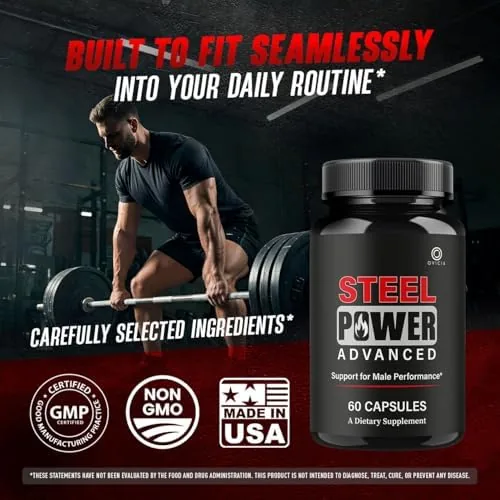
Steel Power names its circulation and hormone-support actives individually, so you can match the formula to your goal instead of guessing from the front of the box.
Check the Official Steel Power OfferWhich one should you choose for your goal?
Start from the outcome, not the aisle. Ask what is actually bothering you, then work backward to the category.
If your issue is drive and circulation in specific moments—everything else feels fine, energy is good, mood is steady—then a circulation-and-libido formula built on L-citrulline is the closer match. It is designed for the near term and the situational, which is exactly the goal you are describing.
If your issue is a broad, slow slide—flatter energy, worse recovery, lower mood and drive together over months—then a testosterone-support approach fits better, because those symptoms cluster around the underlying system rather than the moment. This is the pattern where ashwagandha, zinc, magnesium and vitamin D have their best case, and where the eight-to-twelve-week timeline is a feature, not a frustration.
Low libido specifically deserves a careful note. It can stem from stress, sleep and hormones—territory a supplement can support—but it can also stem from medical causes a supplement will not touch, from medication side effects to vascular or psychological factors. If low drive is persistent, that is a clinician's conversation first, and a supplement decision second. The responsible move is to rule out the causes that need real treatment before reaching for a bottle.
One myth is worth killing here, because it drives a lot of disappointed reviews: the belief that a testosterone booster should work like an enhancement pill—fast, obvious, and situational. It will not, and it is not meant to. Judging a hormone-support formula by whether you feel something the first evening is like judging a savings plan by your bank balance the next morning. The two categories fail in opposite directions when you buy the wrong one: an enhancement formula bought for a slow, systemic slump feels thin because it is aimed at the moment, and a testosterone booster bought for an instant lift feels like nothing because its payoff is weeks away. Naming your real goal up front is what prevents both mistakes.
Can you take both at the same time?
Sometimes—but this is where reading both labels stops being optional. The two categories overlap in their ingredient lists more than the marketing admits: plenty of "enhancement" and "testosterone" formulas share L-citrulline, ginseng or zinc. Stack two products that both contain the same active and you can quietly push that ingredient well past its studied range, which is how well-intentioned combining turns into overdoing it. Zinc is the classic example—easy to double up across products, and problematic at sustained high intakes.
The bigger caution is interaction. L-citrulline can lower blood pressure and interacts with nitrates and some blood-pressure medication; several botanicals interact with blood thinners, sedatives or thyroid drugs. Because almost no multi-ingredient formula has been trialled as a finished product, combining two of them multiplies the unknowns. If you take prescription medication or manage a health condition, the safe path is to check with a healthcare professional before running two supplements together—not to assume that two "natural" products must be safe side by side.
Buy by the ingredient and the goal, not by the word on the front of the box. The panel tells you what a product can actually do; the category name only tells you how it was marketed.
Where Steel Power fits in this comparison
Steel Power is a useful illustration because it does not fit neatly into one bucket—and it does not pretend to. It sits mainly on the vitality and testosterone-support side, built around ashwagandha and supporting minerals for the medium-term hormone-support job, while also including circulation actives like L-citrulline that overlap with the enhancement category. That overlap is common in modern formulas, and it is neither a trick nor a selling point on its own; it is just a fact you verify on the label.
Which is the whole lesson of this comparison. Rather than asking "is Steel Power an enhancement pill or a testosterone booster," the sharper question is "do its named actives match the goal I care about?" Because each one is listed rather than pooled in a blend, you can answer that directly—L-citrulline if your goal is drive and blood flow, zinc and the adaptogenic roots if your goal is hormone support. Our complete Steel Power breakdown lays each active out, and if you want to sharpen your eye for inflated language first, what "proven" really means in men's supplement marketing is the companion read.
Medical note: this article is general information, not medical advice. Persistent erectile difficulty or low libido can have medical causes and deserves a clinician's assessment. Speak to a healthcare professional before starting or combining supplements, especially if you take prescription medication such as nitrates or blood-pressure drugs.
Related reading from the Steel Power library
- Testosterone supplements for men: the full guide
- How to choose the best testosterone booster in 2026
- Does Steel Power work? An honest review
- What "proven" means in men's supplement marketing
Frequently asked questions
What's the difference between male enhancement pills and T-boosters?
They target different goals. Male enhancement pills usually aim at blood flow and libido on a short-term, situational basis, leaning on circulation actives like L-citrulline. Testosterone boosters aim at hormone support built up over eight to twelve weeks using ingredients like ashwagandha, zinc and vitamin D. One is about the moment; the other is about the underlying system.
Which one should I choose for low libido?
It depends on the cause. If low drive tracks with fatigue, poor recovery and low mood over months, a testosterone-support approach fits better. If drive is the main issue and everything else feels fine, a circulation-and-libido formula may suit. Persistent low libido deserves a clinician's input, because it can have medical causes a supplement will not fix.
Can I take both at the same time?
Sometimes, but read both labels first. The risk is doubling up on the same ingredient across two products, or stacking actives that interact with your medication. Because some formulas already overlap, combining them can push certain ingredients too high. If you take prescription drugs or have a health condition, check with a healthcare professional before combining supplements.
Is Steel Power an enhancement pill or a testosterone booster?
Steel Power straddles both sides: zinc and the adaptogenic roots ginseng, maca and Tongkat Ali sit on the testosterone-support side, while L-citrulline is a circulation active of the kind enhancement formulas are built on. That is why the honest move is to read the five named actives on its label and match them to your own goal rather than to a category name.
Scientific references
- NIH NCCIH — Ashwagandha: What You Need To Know
- Cormio L et al. Oral L-citrulline supplementation improves erection hardness in men with mild erectile dysfunction. Urology, 2011 (PMID 21195829)
- NIH Office of Dietary Supplements — Zinc: Fact Sheet for Health Professionals
- NIH NCCIH — Asian Ginseng: What You Need To Know
- Mayo Clinic — Erectile dysfunction: symptoms and causes
Match the formula to your goal, not the label to the hype
Steel Power names its circulation and hormone-support actives one by one. Read the panel on the bottle, match it to your goal, then decide.