Ashwagandha for Testosterone: Dosage & Timeline That Match the Research
Quick Answer: How Much Ashwagandha for Testosterone, and How Long?
Research on ashwagandha for testosterone commonly uses 300–600 mg of a standardised extract daily, often split into two doses, over eight to twelve weeks. Benefits build gradually by lowering chronic stress, so daily consistency matters more than megadosing. Expect at least a month before any change, not days.
- Dose: 300–600 mg standardised extract per day, frequently split morning and evening.
- Timeline: most trials run 8–12 weeks; give it a month minimum.
- Mechanism: it eases cortisol, so it works best in stressed, overtrained or under-slept men.
If you have read even one label in the men's supplement aisle, you have seen ashwagandha for testosterone promoted somewhere on the box. It has become the flagship botanical of the category, and for once the hype has real research underneath it. But the two questions that decide whether ashwagandha for testosterone actually does anything for you—how much to take and how long to wait—are exactly the two the marketing tends to blur. This guide fixes that, walking through the mechanism, the human evidence, the studied dose range, and a realistic timeline you can plan around.
Here is the honest headline before we go deep: ashwagandha is not a switch. It does not spike testosterone the day you take it, and it does not work equally well for every man. Its effect runs through your stress physiology, which means it rewards the patient and the genuinely stressed far more than the impatient and the already-relaxed. Understanding why is the difference between using it well and quitting at week two.
How ashwagandha works: the cortisol see-saw
Ashwagandha (Withania somnifera) is classed as an adaptogen—a plant that helps the body regulate its response to stress. Its most consistent, best-documented effect in human trials is a reduction in cortisol, the hormone your adrenal glands pump out under chronic pressure. That single effect is the engine behind everything else.
Cortisol and testosterone behave like the two ends of a see-saw. When chronic stress keeps cortisol elevated for weeks and months, the hormonal environment tilts away from testosterone production and recovery. Your body, sensibly, prioritises surviving the perceived threat over building muscle, drive and vitality. By dialling down that chronic stress signal, ashwagandha lets the see-saw settle back toward balance, and testosterone can recover toward where your physiology intends it to sit.
This is why the mechanism matters so much for expectations. Ashwagandha is not adding testosterone or forcing your testes to overproduce. It is removing a brake. If chronic stress is a significant brake on your system—because you are overtrained, under-slept, or grinding through a high-pressure stretch of life—releasing it can produce a genuine, measurable shift. If stress is not really your limiting factor, there is less brake to release, and the effect is smaller. That single insight explains most of the variation between men who rave about it and men who shrug.
What the evidence actually shows
The research base is one of the better ones in this category, though it is not enormous and it deserves honest framing. Several randomised, placebo-controlled trials in men—often stressed adults or resistance-training participants—have reported increases in serum testosterone alongside reductions in cortisol, improvements in perceived stress, and gains in measures of sexual well-being and vitality. One frequently cited eight-week trial used 300 mg of a standardised root extract twice daily and reported significant improvements in serum testosterone and sexual well-being versus placebo.
The caveats keep the picture honest. Sample sizes are typically modest, durations are short, extract standardisation varies between products, and a share of the work has commercial backing. The effect sizes are real but moderate, not dramatic, and they show up most reliably in men who were stressed or training hard to begin with. Ashwagandha earns a solid mid-to-upper spot when you rank the category—we place it in context in our male vitality ingredients ranked by evidence tier—precisely because the human data is repeatable without being overwhelming. It is one of the few botanicals here where the label claim and the literature are in the same room.
Adaptogens on a label that names its actives
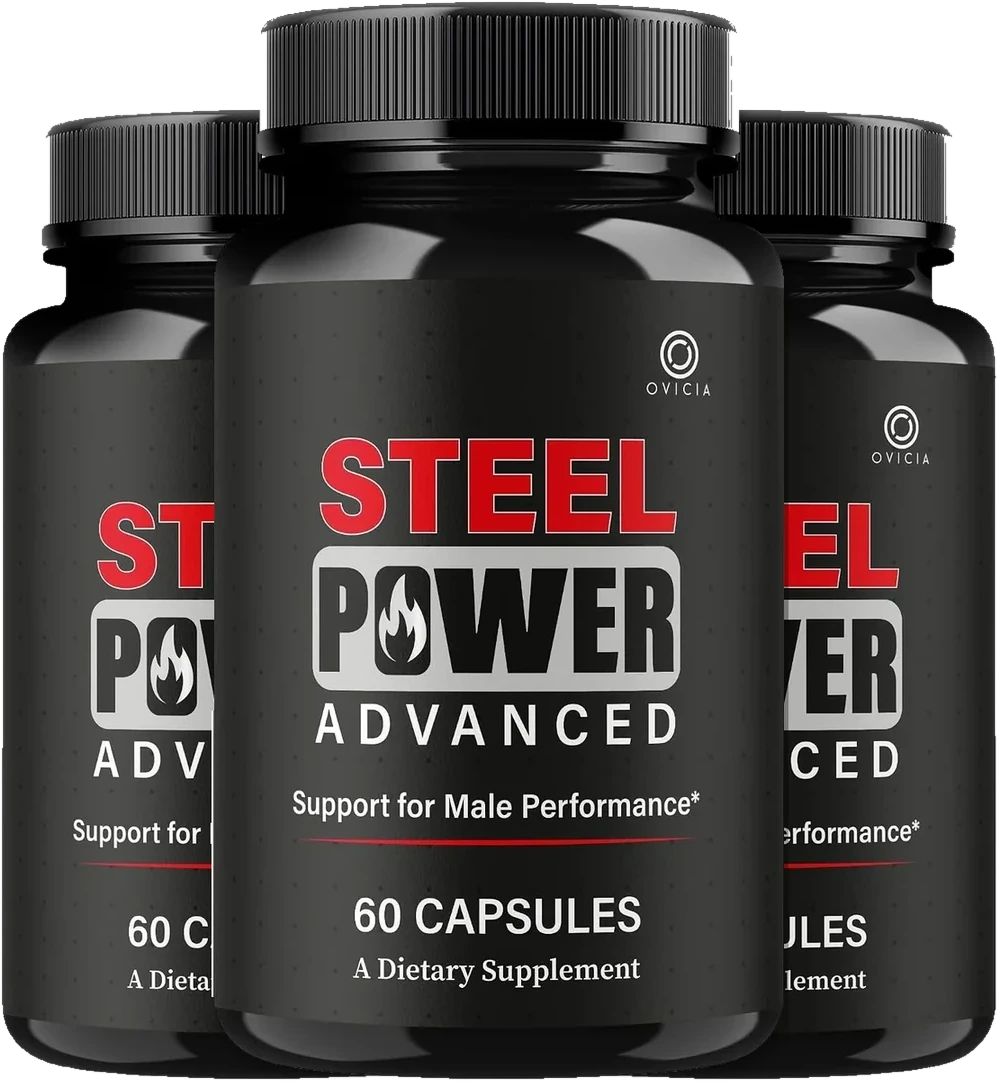
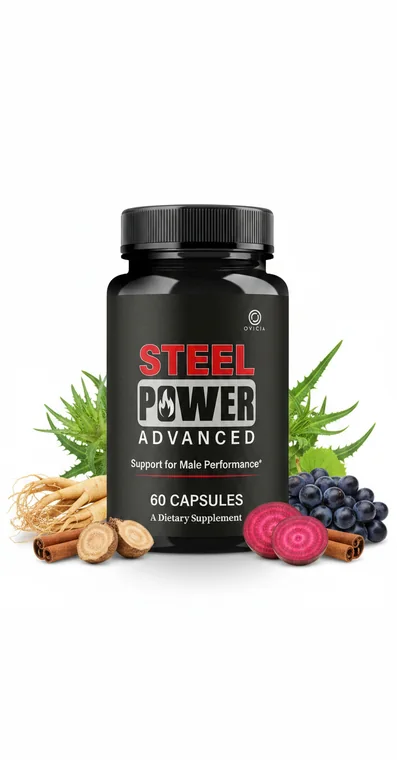
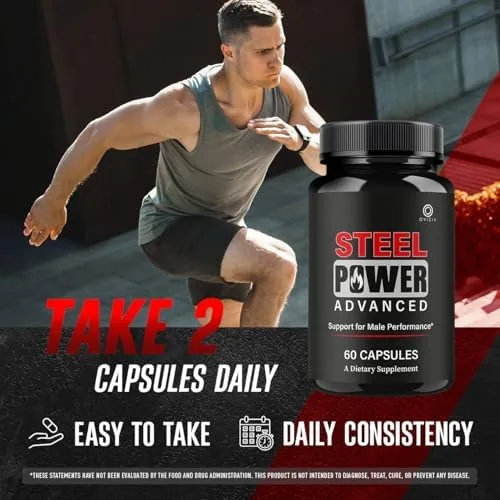
Steel Power takes a different adaptogen route: its label names Panax ginseng, maca root and Tongkat Ali rather than ashwagandha, so use the dosing logic here to judge whichever adaptogen you end up buying.
Check the Official Steel Power OfferThe right dose: why 300–600 mg is the number that matters
Across the trials that report benefits, the daily dose clusters in a tight, useful range: roughly 300 mg to 600 mg of a standardised root extract, frequently split into two servings taken morning and evening. Splitting the dose keeps blood levels steadier through the day and mirrors how much of the research was actually conducted. The standardisation matters too—extracts are commonly standardised to a percentage of withanolides, the active compounds—because "ashwagandha" on a label can mean anything from a concentrated extract to a spoonful of raw root powder with a fraction of the potency.
The temptation, once you know a dose works, is to assume double the dose works double. It does not. There is no evidence that pushing well beyond the studied range delivers proportionally bigger gains, and higher intakes raise the odds of side effects like drowsiness or digestive upset without a matching payoff. This is a rare case where the research hands you a clear ceiling and a clear floor. Land inside the range, standardised, split across the day, and you have matched the intervention that produced the results—which is the whole point of dosing by evidence rather than by hope.
The timeline: why patience is the active ingredient
This is where most people go wrong. Ashwagandha is not a stimulant and it is not a pre-workout. It works by shifting your stress physiology over time, and that shift accumulates. The trials that report benefits almost all run eight to twelve weeks, and the meaningful changes build over at least one full month of daily use. If you take it for four days, feel nothing, and quit, you have not tested ashwagandha—you have tested your own impatience.
A realistic timeline looks like this. In the first week or two, some men notice a subtle smoothing of stress or better sleep before anything hormonal is measurable—an early sign the cortisol side is responding. Through weeks three to six, the effects on stress, recovery and drive tend to consolidate. By weeks eight to twelve, you are in the window where the trials measured their testosterone changes. The single biggest predictor of whether you land in the responder group is simply whether you took it consistently, every day, for long enough. Missing doses or cycling on and off resets the clock, because you are interrupting the very process that needs continuity. If you want the broader picture on how support ingredients accumulate, our guide to how long testosterone boosters take to work puts ashwagandha's timeline alongside the rest.
Three objections worth answering honestly
"If it just lowers stress, why not skip it and manage stress directly?" You should do both, and that is the point rather than a contradiction. Sleep, training, and workload are the primary levers, and no capsule replaces them. Ashwagandha is a support that makes the stress side easier to move, especially in stretches of life when you cannot simply remove the pressure. It is an assist, not an alternative to living well.
"Doesn't this just work for people who were stressed and sleeping badly?" Largely, yes—and that is a feature, not a flaw, as long as you are honest about it. The men with the most chronic-stress "brake" to release see the biggest shift. If your stress is already low and your sleep is excellent, expect a smaller effect, because there is less to correct. Matching the ingredient to your actual bottleneck is exactly the discipline that separates smart supplementing from hopeful supplementing.
"Will it push a healthy man's testosterone into the stratosphere?" No, and you would not want it to. Like the best-evidenced ingredients in this space, ashwagandha helps a system recover toward its own normal, not blast past it. It is a support tool, and it does not diagnose or treat clinically low testosterone—that remains a matter for a blood test and a clinician.
Ashwagandha rewards consistency, not intensity. The men who benefit most are the ones who take a studied dose every day for two months—not the ones who take a huge dose for a week.
Does Steel Power contain ashwagandha, and why disclosure matters
The most common trick in the aisle is to print "ashwagandha" prominently on the front of the box while burying the actual amount inside a proprietary blend—a group of ingredients listed under one combined weight. That lets a product ride the ingredient's reputation while potentially including a fraction of the researched dose. You simply cannot tell.
Steel Power does not contain ashwagandha at all. Its label names five actives — L-citrulline, Panax ginseng, maca root, Tongkat Ali and zinc — and per-capsule amounts were not published on the pages we reviewed, so if a milligram figure matters to you, read the panel on the bottle in front of you rather than a marketing page. That is the whole value of naming actives: it turns "trust us" into "check for yourself." Before you buy any formula built around ashwagandha, our full Steel Power breakdown shows how it lays out each active and dose so you can run exactly this comparison.
Medical note: this article is general information, not medical advice. Ashwagandha can interact with thyroid, sedative and immune-modulating medication, and is not recommended in pregnancy. Speak to a healthcare professional before starting it, especially if you take prescription drugs or manage a health condition.
Related reading from the Steel Power library
- Natural ways to boost testosterone that actually work
- The natural testosterone booster buyer's guide
- How long testosterone boosters take to work
- Male vitality ingredients ranked by evidence tier
Frequently asked questions
How much ashwagandha should I take for testosterone?
Human trials commonly use 300 to 600mg of a standardised root extract daily, often split into two doses. One well-cited trial used 300mg twice daily for eight weeks and reported significant serum testosterone and sexual well-being gains. More is not better here; consistency at the studied dose matters far more than pushing the amount higher.
How long until ashwagandha affects testosterone?
Give it time. Most trials run eight to twelve weeks, and benefits build over at least one month of daily use rather than appearing in days. Ashwagandha works gradually by lowering chronic stress load, so daily consistency matters more than any single dose. If you stop and start, you reset the clock.
Does ashwagandha work by lowering stress?
Largely, yes. Ashwagandha is an adaptogen that moderates the stress hormone cortisol, and because cortisol and testosterone sit on opposite ends of a see-saw, easing chronic stress can let testosterone recover. That is the best-supported mechanism. It also means its effect is largest in men who are genuinely stressed, overtrained or sleeping poorly.
Does Steel Power contain ashwagandha?
It does not contain ashwagandha. The Steel Power label names five actives — L-citrulline, Panax ginseng, maca root, Tongkat Ali and zinc — and its adaptogen role is filled by ginseng, maca and Tongkat Ali instead. Per-capsule amounts were not published on the pages we reviewed, so read the panel on your own bottle before comparing anything to the 300 to 600 mg ashwagandha range in this article.
Scientific references
- NIH NCCIH — Ashwagandha: What You Need To Know
- Lopresti AL et al. A randomized, double-blind, placebo-controlled, crossover study examining the hormonal and vitality effects of ashwagandha (Withania somnifera) in aging, overweight males. American Journal of Men’s Health, 2019 (PMID 30854916)
- Ambiye VR et al. Clinical evaluation of the spermatogenic activity of the root extract of ashwagandha (Withania somnifera) in oligospermic males: a pilot study. Evidence-Based Complementary and Alternative Medicine, 2013 (PMID 24371462)
- NIH Office of Dietary Supplements — botanical dietary supplements background
- Mayo Clinic — drugs and supplements: evidence and safety notes
Ashwagandha for testosterone, and where Steel Power differs
Steel Power is not an ashwagandha product — its named adaptogens are Panax ginseng, maca root and Tongkat Ali. Read its label the same way you would read an ashwagandha one, then decide.